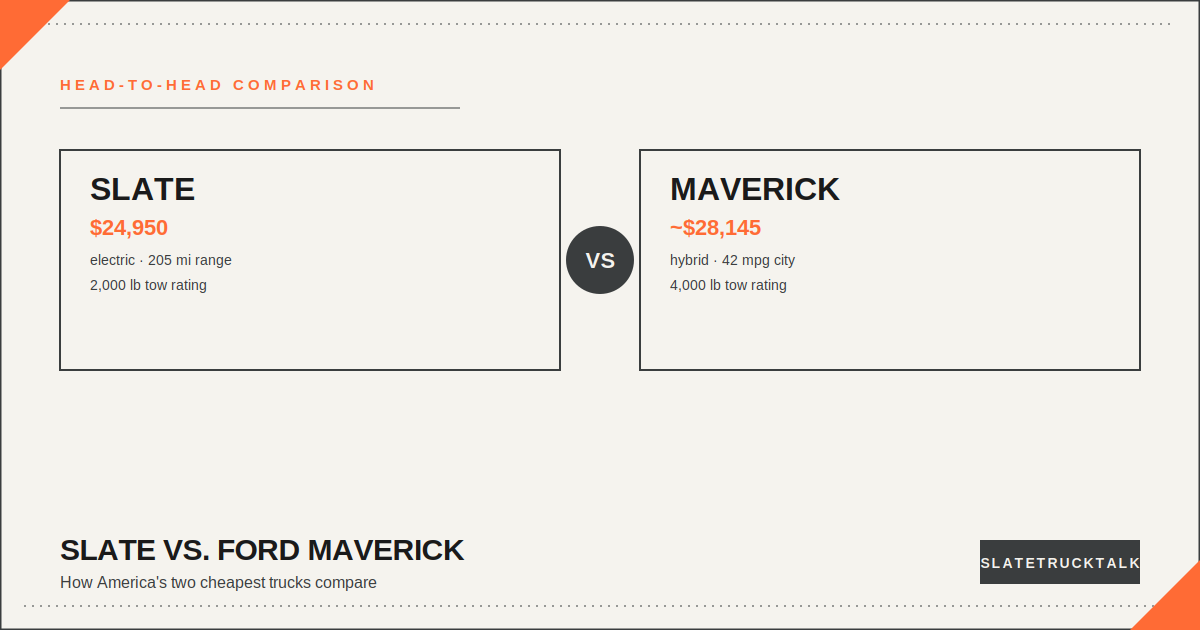
Slate has explicitly positioned itself against the Ford Maverick, calling itself “the most affordable truck in America.” That’s a direct shot at the Maverick, which has held that title for years. Now that both trucks have real, current pricing and specs, here’s how they actually stack up.
Pricing
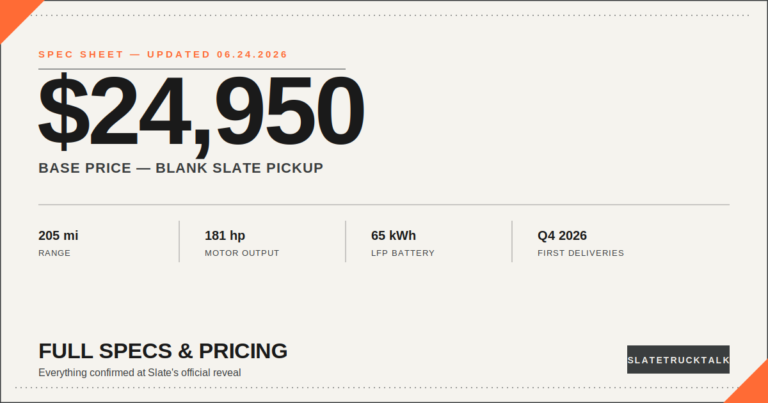
- Slate Truck: $24,950 starting price (excludes tax, title, destination, and fees — Slate hasn’t announced its destination charge yet). See our full Slate Truck specs and pricing breakdown for every detail.
- Ford Maverick XL Hybrid: starting MSRP around $28,145, which already includes destination charge depending on the source — expect an out-the-door price in the high-$20,000s to low-$30,000s once tax and fees are added
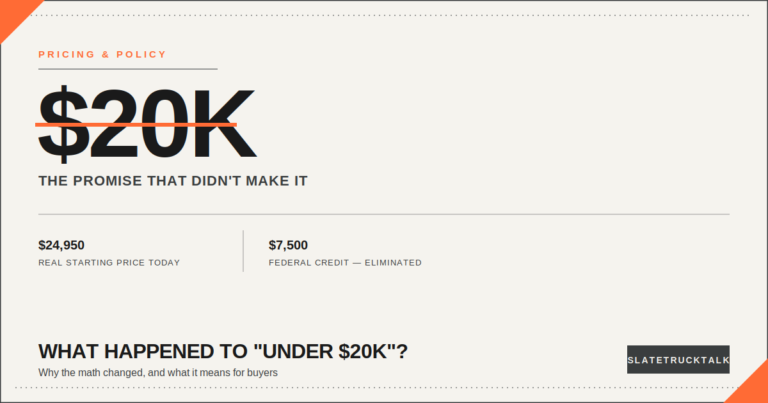
Even accounting for Slate’s still-unannounced destination fee, Slate is positioned to undercut the Maverick by roughly $3,000–4,000 at the base trim level. Worth noting: Slate’s original pitch was an even lower sub-$20,000 price, before the federal EV tax credit was eliminated — so the gap between these two trucks used to look a lot bigger.
Powertrain
| Slate Truck | Ford Maverick XL Hybrid | |
|---|---|---|
| Drivetrain | Electric, single rear motor, RWD only | Gas-electric hybrid, FWD standard (AWD optional) |
| Horsepower | 181 hp | 191 hp (combined hybrid output) |
| Torque | 195 lb-ft | 155 lb-ft (gas engine) + 173 lb-ft (electric motor) |
| 0-60 mph | ~8.0 seconds (Slate’s estimate) | not officially published, generally tested in the 7.5-8.5 second range for the hybrid |
| Fuel/Energy | 205 miles electric range, NACS fast charging | Up to 42 mpg city / 35 mpg highway, traditional gas refueling |
This is really a choice between two different ownership models, not just two trucks. The Maverick uses a conventional gas station for refueling and has years of established reliability data. The Slate is electric-only, which means home or public charging access matters a lot more for how practical it is day-to-day — and its 205-mile range is meaningfully shorter than what most other current EVs offer.
Bed and Cargo
- Slate Truck: 5-foot bed, 35.1 cubic feet, plus a 7.0 cubic foot front trunk
- Ford Maverick: approximately 4.5-foot bed (54.4 inches), around 33.3 cubic feet, FLEXBED storage system with built-in tie-downs and a 2-inch hitch receiver standard on most trims
Slate edges out the Maverick slightly on raw bed volume and adds frunk storage the Maverick doesn’t have. The Maverick’s FLEXBED system, however, includes more built-in organizational features out of the box.
Payload and Towing
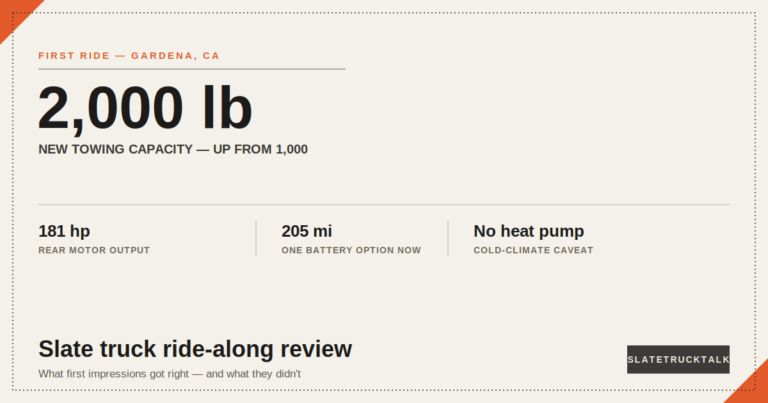
- Slate Truck: 1,550 lbs payload, 2,000 lbs towing
- Ford Maverick: up to 1,500 lbs payload, up to 4,000 lbs towing (with the 4K Tow Package and EcoBoost engine; the base hybrid tows less without the package)
This is the Maverick’s clearest advantage: with the right configuration, it tows twice what the Slate can. If towing is a priority — a trailer, larger boat, etc. — the Maverick has more headroom. For light-duty towing (small trailers, a couple of jet skis, as Slate has specifically marketed it), the Slate’s 2,000-lb rating is adequate but not in the same class.
Interior and Tech
This is where the two trucks diverge the most in philosophy:
- Slate: no touchscreen, hand-crank windows standard, physical knobs, phone/tablet mount instead of built-in infotainment — deliberately stripped down with the expectation that you add what you want via the accessory marketplace
- Maverick: standard 13.2-inch touchscreen with wireless Apple CarPlay/Android Auto, digital instrument panel, power windows, and a more conventional modern truck interior even at the base XL trim
If you want a no-frills vehicle as a deliberate choice — and plan to personalize it yourself — Slate’s approach is the more unusual option in today’s market. If you just want a normal truck experience for less money, the Maverick already gives you that without needing to add anything.
Bottom Line
The Slate undercuts the Maverick on price and offers a genuinely novel “build it your way” approach with EV running costs. The Maverick wins on towing capacity, proven reliability, refueling convenience, and out-of-the-box comfort/tech. Which one makes sense really comes down to whether you value the lower price and EV ownership enough to accept a barer interior and shorter range, or whether the Maverick’s flexibility and conventional ownership experience is worth the few thousand dollars more.
Cross-shopping these two? Let us know what’s tipping your decision in the comments.