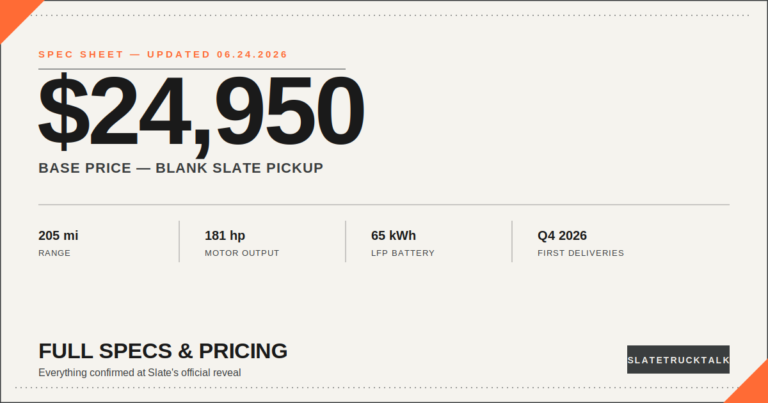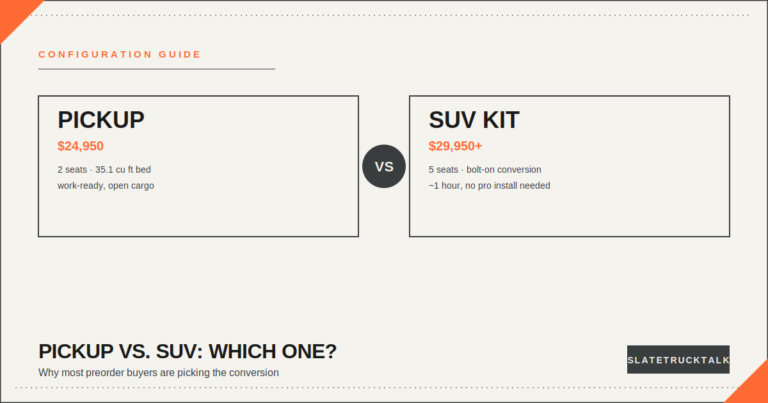
The Slate truck EV market outlook is more complicated than the price tag suggests. Slate Auto’s $24,950 truck is officially the cheapest new truck sold in America, undercutting a base Ford Maverick XL by more than $2,000. That’s the headline. The more interesting question — the one analysts started asking this week — is whether that price actually works as a business, at a moment when the broader EV market is in genuine trouble.
What the Slate Truck EV Market Outlook Looks Like Right Now
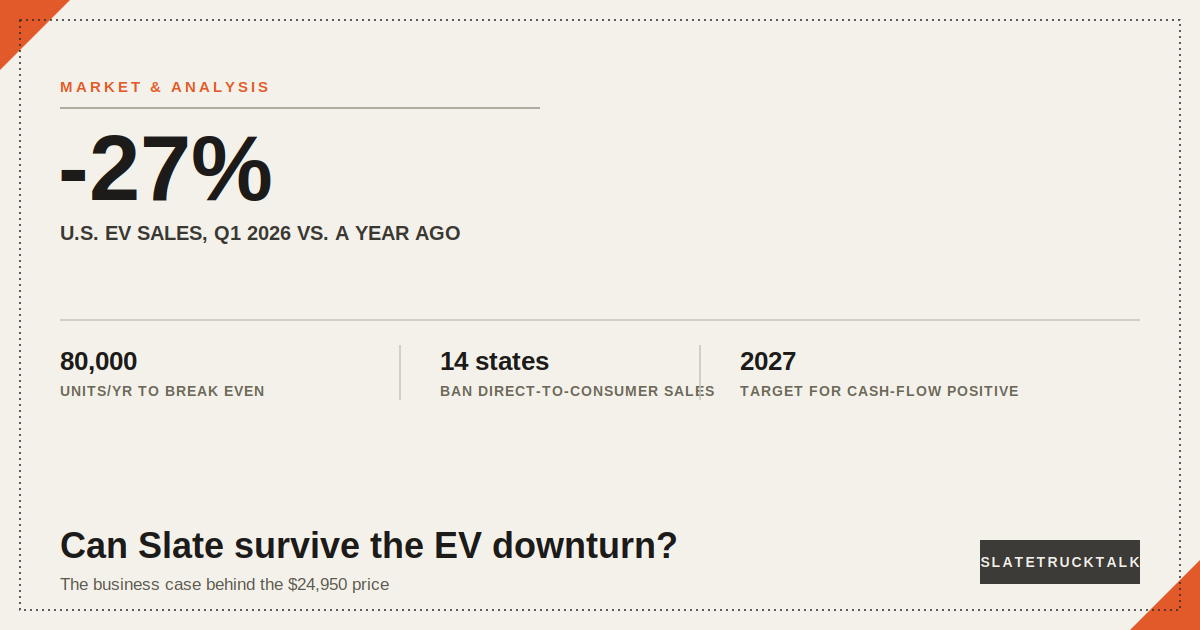
New EV sales in the U.S. fell 27% year-over-year in the first quarter of 2026, dropping to around 216,400 units, according to Cox Automotive’s Kelley Blue Book data. Ford already pulled the plug on the F-150 Lightning late last year, with CEO Jim Farley saying outright the electric truck wasn’t profitable enough to keep building. That’s the backdrop Slate is launching into — not a booming EV market eager for new entrants, but one that just lost its federal purchase incentive and is actively contracting. For the full breakdown of what $24,950 actually buys, see our Slate truck specs and pricing guide.
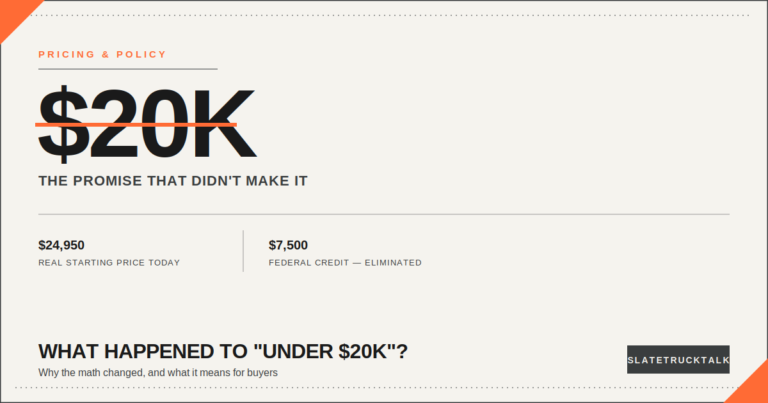
The $7,500 federal EV tax credit that existed when Slate first revealed itself in April 2025 is gone, eliminated for both new and used EVs effective September 30, 2025 — a shift we covered in detail in what happened to Slate’s original under-$20k promise. Slate has been consistent in saying its $24,950 price was never contingent on that credit — but that’s a harder sell to the 180,000-plus reservation holders who came in expecting something closer to $20,000 with the credit applied.
How Slate Says the Math Works
CEO Peter Faricy told CNBC every truck sold at $24,950 is expected to be gross-margin positive from day one, with the company targeting overall cash-flow positivity by 2027. Three engineering decisions underpin that claim:
- No paint shop. Trucks ship in a single gray composite material that’s colored all the way through; exterior color comes from aftermarket wraps, not factory paint — avoiding one of the most capital-intensive parts of a traditional auto plant. Faricy has cited roughly $350 million saved by skipping painted steel entirely.
- A cobalt-free LFP battery. LFP cells run roughly $80–100 per kWh versus $120–150 for the nickel-based chemistry most EVs use, and the cells last longer — an estimated 3,000 to 5,000 charge cycles versus 1,000 to 1,500 for nickel-based packs.
- Radical parts reduction. A conventional pickup arrives at the assembly line with roughly 2,500 distinct parts; Slate’s uses around 500.
Slate also sells direct to consumers, skipping the franchise dealer network entirely — the model Tesla pioneered and Rivian and Lucid have since followed.
The Break-Even Number That Matters Most
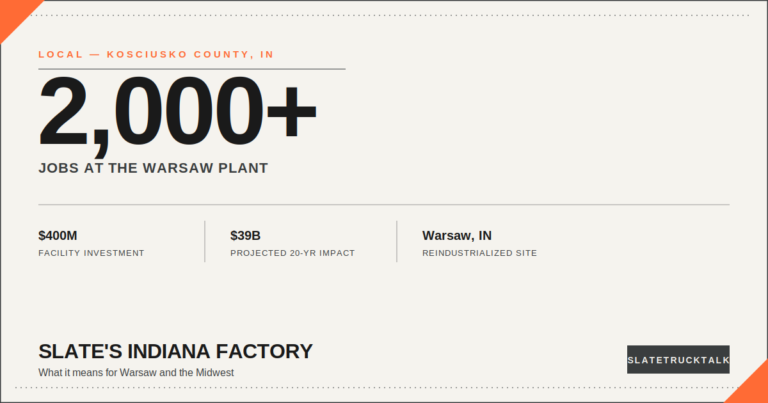
Slate’s break-even production volume sits at roughly 80,000 vehicles a year — just over half of the 150,000-unit annual capacity its Warsaw, Indiana plant is built for. That’s the number that matters most here. Slate doesn’t need to sell out its factory to turn a profit; it needs to sell roughly half of it. With 180,000-plus reservations already on the books, the company has more demand signal than most startups ever see before their first delivery.
The Complication No Spec Sheet Mentions
There’s a regulatory wrinkle that doesn’t show up anywhere in Slate’s marketing: at least 14 states expressly ban manufacturers from selling vehicles directly to consumers, and others require case-by-case regulatory approval — a holdover from mid-20th-century laws designed to protect independent franchise dealers. Tesla spent years fighting these laws state by state. Slate, betting its entire go-to-market on the same direct-sales model, inherits that same fight. Anyone holding a reservation in a state with known restrictions should confirm Slate’s actual availability before upgrading to the non-refundable $300 deposit.
The Skeptic’s Case
Edmunds’ director of insights, Ivan Drury, has been one of the more measured voices here. His read: the low base price is the headline, but it’s paired with an unconventional build and a powertrain category that’s proving harder to sell in 2026 than it was a year or two ago. Early hands-on impressions of the truck back that up — a noisy cabin and crank windows aren’t going to make the EV-skeptic case any easier. In other words, Slate isn’t just competing on price — it’s asking buyers to also accept a genuinely stripped-down vehicle and an EV drivetrain at a moment when both are tougher sells than they used to be.
Where That Leaves Reservation Holders
None of this changes what a Slate truck costs today. But it’s useful context for the 180,000 people deciding whether to convert their $50 reservation into a $300 non-refundable deposit within the 30-day window. The price is real, and it isn’t moving because of subsidy changes. Whether Slate can keep that price while building enough trucks profitably is the part still being decided — and it’s worth understanding before you commit.
Sources: Cox Automotive/Kelley Blue Book Q1 2026 EV sales data; CNBC interview with Slate CEO Peter Faricy; Edmunds analysis.